
January 25th, 2017 ~ Vol. 87 No. 4
$1.00
CNP Fire and Rescue department holds ice rescue training
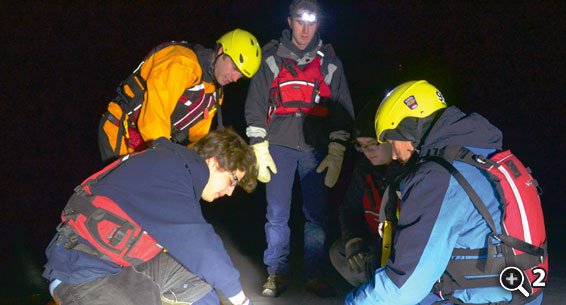
Anna Kroupina Photo
The Crowsnest Pass Fire and Rescue Department held an ice rescue training session at Crowsnest Lake on Jan. 18. Darren Lefort (top left) teachs the group how to set up a three-to-one hauling system used to pull victims out of the water.
ANNA KROUPINA
Pass Herald Reporter
In some countries, it’s considered a spa activity or spiritual experience, but for the CNP Fire and Rescue Department, jumping into the 5-degree water of Crowsnest Lake on Jan. 18 was part of their ice rescue training.
According to Lieutenant Evan Stewart, the weather was perfect for the mission, with “stagnant water” and “crappy ice” out on the lake. Stewart is also the commander of the Water Rescue Team.
“I’ve been out there swimming already,” he said during the debriefing. “We found a couple of holes, some nice, deep spots. It’s going to be very controlled, very safe. I promise no one is going to get hurt.”
While this was not the department’s first time implementing an ice rescue session, it was the first such training for all firefighters that went into the water that evening.
According to Lieutenant Evan Stewart, the weather was perfect for the mission, with “stagnant water” and “crappy ice” out on the lake. Stewart is also the commander of the Water Rescue Team.
“I’ve been out there swimming already,” he said during the debriefing. “We found a couple of holes, some nice, deep spots. It’s going to be very controlled, very safe. I promise no one is going to get hurt.”
While this was not the department’s first time implementing an ice rescue session, it was the first such training for all firefighters that went into the water that evening.
continued below ...
Two stands were set up on the ice, both of which taught different components of ice rescue. On the left side was the rope stand, in which firefighters learned about the anchor rope system, twisted in ice screws and set up a three-to-one hauling system for pulling victims out of the water. On the right was the dunking hole, where firefighters intentionally fell through ice, learned how to get out of the water and got the feel of wearing an ice suit.
“The purpose of today was to get roughly 10 more of our firefighters trained up to an operational standard in ice water safety and rescue,” says Stewart. “We have about five technicians who will do contact rescues and swims, but the remaining personnel in the fire department are trained up to an operational standard in all of our technical rescue disciplines so that they can be useful on-scene.”
Although the newly trained firefighters won’t be the ones pulling victims out the water, Stewart highlighted their vital role in a water rescue situation.
“Operation personnel are extremely useful because having trained people to run our rope system on shore and prepping our equipment for us while we’re getting suited up saves precious seconds,” he says.
“The purpose of today was to get roughly 10 more of our firefighters trained up to an operational standard in ice water safety and rescue,” says Stewart. “We have about five technicians who will do contact rescues and swims, but the remaining personnel in the fire department are trained up to an operational standard in all of our technical rescue disciplines so that they can be useful on-scene.”
Although the newly trained firefighters won’t be the ones pulling victims out the water, Stewart highlighted their vital role in a water rescue situation.
“Operation personnel are extremely useful because having trained people to run our rope system on shore and prepping our equipment for us while we’re getting suited up saves precious seconds,” he says.
continued below ...
Brendan Busato has been with the department for seven months, and it was his first time wearing an ice suit and participating in such training.
“I was expecting it to be very cold, but in these ice suits, you end up sweating more than anything,” he says. “They keep you very warm, and that was really unexpected.”
“I was expecting it to be very cold, but in these ice suits, you end up sweating more than anything,” he says. “They keep you very warm, and that was really unexpected.”
Click the "Submit" button once
Your post will appear at the top
Your post will appear at the top
HOME PAGE
passherald@shaw.ca
403-562-2248
$1.00
January 25th, 2017 ~ Vol. 87 No. 4
All information on this website is Copyright (c) 2017 Pass Herald Ltd. All rights reserved.
12925 20th Ave, Box 960, Blairmore, Alberta, Canada T0K 0E0 | passherald@shaw.ca | 403.562.2248 | 403.562.8379 (FAX)
12925 20th Ave, Box 960, Blairmore, Alberta, Canada T0K 0E0 | passherald@shaw.ca | 403.562.2248 | 403.562.8379 (FAX)
but at times some comments are removed.